



Cunard’s Britannia Club: What Travel Advisors Need to Know
by John and Sandra Nowlan
The Queen Elizabeth. Photo: John Nowlan
The cruise director said it was Cunard’s best kept secret.
Better rooms, more elegant dining, and exclusive perks put Britannia Club passengers in a special category. It’s often called a “halfway house” between basic Britannia rooms and the ultra-luxury Princess and Queens Grills. The price difference between a Britannia balcony room and a Britannia Club stateroom was about $600 for our nine-day Caribbean cruise. To move from a Club room to a Princess Grill suite would cost an additional $2,600.
We’ve sailed with Cunard several times, but this was our first experience with Britannia Club. Our ship was Queen Elizabeth, built in 2010 with an art deco interior reminiscent of the original Queen Elizabeth of the 1930s.
For the first time, this Queen is based in Miami for a series of popular Caribbean cruises.
The demographic mix among the 1,900 passengers was interesting – an equal number of American and British guests plus significant contingents of Canadians and Australians.

Britannia Club Accommodations
Our Britannia Club room was slightly larger than normal Britannia accommodation (248 vs 228 square feet) and had a balcony significantly larger. All Club staterooms are in a quiet mid-ship area on decks 7 and 8 for smoother sailing.
We were in room 8033 on the starboard side. Our additional perks included a full bottle of sparkling wine and a specialty tea and coffee maker. Spring water in glass bottles was always replenished and fresh fruit could be ordered daily. For comfort, a pillow concierge menu was available, and the bathrobes were upgraded velour. Unfortunately, slippers came in only one size, too big for Sandra, too small for John.
The bathroom was the standard Britannia size with a small shower stall but the toiletries – shampoo, conditioner, body wash, and hand soap – were by high-end Penhaligon’s of London.

Britannia Club Dining
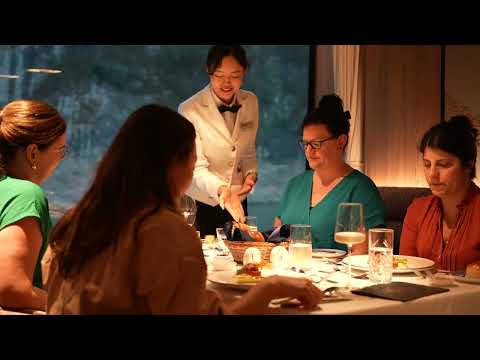
We found the most distinctive difference between Britannia and Britannia Club was the dining. Club guests have the exclusive use of the most intimate of the four main dining areas. Capacity in our narrow but spacious room near the back of Deck 2 was just 92 while the Princess Grill serves 120 guests and the Queens Grill can handle 132. The regular Britannia restaurant covers two decks at the back and can accommodate 900 guests.
In the Club, most of the tables are for two but guests can also choose a table for four, six, or eight. The assigned table became the guest’s restaurant home for breakfast, lunch, and dinner.
Dinner on our sailing ran from 6 to 8:30 pm and we could arrive at our window table for two anytime we wanted. No waiting. If we ate elsewhere, the table stayed vacant.
Because of its more intimate size, we always felt special when dining in the Club. The same spiffy waiters (dark suits at dinner), both of whom are Cunard veterans, got to know us well (and vice versa) and were efficient and attentive throughout the cruise. We never felt rushed or ignored.
The Britannia Club had the same breakfast and lunch menus as the Britannia restaurant but in the evening featured two menus, the basic Britannia menu that changed each day and a separate enhanced menu for Club guests.
Britannia usually gets good marks for its cuisine, and we were impressed with dishes like Beef Wellington, Pork Cordon Bleu, and Poached Filet of Plaice. The separate a la carte Britannia Club menu was even more imaginative with choices including Coquille Saint-Jacques, Duck à l’Orange. and Roast Rack of Dorset Lamb. Our lamb dish was particularly outstanding, probably the best we’ve had at sea.
Another Club restaurant exclusive is its flambé desserts. We were impressed when the restaurant manager, Willy Gracias, prepared our peach flambé tableside. He was careful to avoid standing under a sprinkler!
Specialty Dining on Queen Elizabeth
Like many other Club guests, we wanted to explore Queen Elizabeth’s range of culinary venues, so we first booked Bamboo, an extra-cost Asian specialty restaurant on the Lido deck ($45 pp). Its Bento Box appetizer was a delight followed by a tasty Japanese style halibut.
The most expensive restaurant option is the Steakhouse at the Verandah ($65 pp), an elegant room with fine service (even a choice of steak knives) and large portions. Our crabcake and roasted marrowbone appetizers were followed by a New York striploin and an American Wagyu striploin. Both were good but, surprisingly, the New York cut was more tender than the Wagyu.
Being on a ship with a proud British heritage (the Cunard line goes back 185 years) we had to try some pub food and the Golden Lion, a no-extra-charge staple on all four Cunard ships, was a must-stop. We weren’t disappointed. The deep-fried cod and chips, Scotch eggs, and sticky toffee pudding were all excellent.

Cunard Entertainment
Cunard has a reputation for excellence with its speakers and entertainment. The most interesting presenter on our sailing was a British professor, now retired from Old Dominion University, who spoke about unusual cloud formations (more fascinating than it sounds) and the atmospheric illusions that may have fooled the lookouts on the Titanic on that fateful night. The grand Queens Room in the center of the ship was the venue for a long-standing Cunard tradition, a formal afternoon tea, available for everyone. After dark the Queens Room came alive with the sounds of the biggest Big Band at sea. The dance floor was always full.
Queen Elizabeth’s 800 seat Royal Court Theatre, designed to duplicate a grand London West End showplace (with private boxes), was the venue for entertainment each evening. We saw an acrobat juggling knives atop a tall unicycle and several good singing acts, but our favorite was a Cunard first. The company obtained exclusive cruise ship rights to the Tony winning Broadway musical, “Come From Away,” with the stipulation that the show was presented in its full hour and 45-minute entirety. It was an ideal fit for Cunard – a feel-good production about the small-town welcome received by more than 6,500 stranded passengers after airplanes were diverted to Gander, Newfoundland, on 9/11. International friendship at its best.
All in all, we enjoyed all the benefits of the Britannia Club option while participating in so many shipboard activities. The upgrade still appears to be little known (hence, the “best kept secret”) even though it started on Queen Mary 2 in 2007 and was added to the other Queens in following years.
Our conclusion? For a relatively small additional cost, it adds major value and pleasure to a Cunard sailing.